The Challenge
There are a number of drivers behind The Open School. Not least, issues around learner absence, school relevance, and the many barriers that we have created for young people – particularly our secondary aged learners - before they can find meaning and fully engage with their own education.
But the idea of The Open School is not meant to be a drip bucket in a grey cloud of educational problems. The Open School is meant to be the sunshine that dries out some of the rain, open for all young people in the secondary phase.
We can do so much better for our young people, can’t we? As the Prime Minister said in September, education needs to be reformed so that “children have more control of their future”.
Although actually, shouldn’t we go one step further and give children more control of what they do today, not just a future that sits on an unspecified horizon?
What if… every young person – whatever their background or location – had access to vocational, recreational, creative, competitive and aspirational learning?
What if… we removed that arbitrary separation between curriculum and extra-curricular?
What if… we intelligently use contemporary technologies to make learning more personalised, more accessible, more connected, and more relevant, to the world that young people actually live in?
If as adults we embrace the benefits of on-demand, personalised, anywhere/anytime tools that help us with our tasks and priorities, why would we prevent young people from safely utilising those same tools?
What if… young people’s aspirations (not just our targets for them), were mapped to opportunities, coached, and nurtured through properly joined-up provision?
What if… the curriculum and qualification pathways available to young people could break free from the shackles of location, of teacher capacity and local socioeconomics?
If a child attends a small school or a school that is not yet thriving, why would we accept that their subject and qualification options will be much narrower than a child in a neighbouring school?
What if… the career pathways for our teaching workforce were not constrained by the structures of time, place and imagination?
If we have an inspirational physics teacher in one school and a vacancy in another, why would we accept the inequality that creates for the children involved rather than just use technology to connect the two together?
You know the saying ‘that it takes a village to educate a child’? Well, what if… we removed some of the unnecessary barriers and empowered young people to access the wide range of support networks that already exist – within, and beyond their physical or ‘home’ school.
The life changing impact The Open University had for adults is well documented – democratising access to learning through structured anytime/anywhere provision, and meaningful student/tutor relationships. But, when the idea of The Open University was originally proposed, it wasn’t welcomed by those whose identities were tied to traditional models. It took time, but the Open University has since helped to revolutionise the very idea of what ‘going to university’ means.
So imagine what impact Open School could make…
Not replacing, but complementing, existing schools. Providing opportunities for the existing workforce. Most importantly, breaking down the many barriers that we are know are there, and that we know can – in 2026 – be overcome.
Over the last 4 years, we have been working hard in the background to make the Open School aspiration into a reality. Voices across the sector have fed into discussions and design thinking which has touched upon funding and operational models, governance and accountability, partnerships and communications. We are incredibly excited about the 12 regional pathfinding projects that are building momentum within this work.
Together, we can make this happen.
What is the issue we are trying to address?

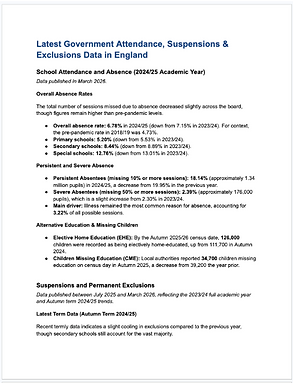
What does the data tell us?

What can we learn from research?

Vision
The Open School Vision


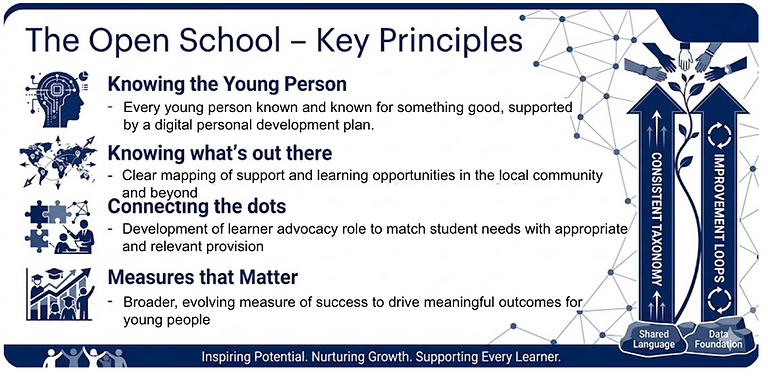
Key Principles
How it works
Operational Model

4 Pillars

Ensuring reality reflects vision
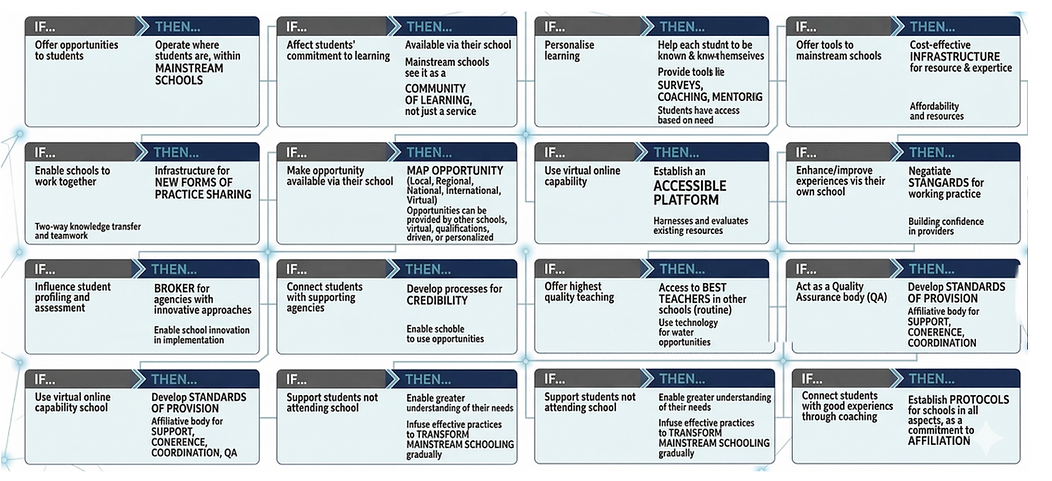
In Practice
What happens when schools join?

Learner Advocacy

